
Artificial intelligence (AI) has moved from buzzword to boardroom priority. Organizations that hesitate now may watch rivals pull ahead in productivity and customer loyalty. AI streamlines operations, uncovers hidden insights, and creates personalized experiences that once sounded like science fiction. Yet many teams still struggle to convert interest into real impact. This is where the combination of AI and C# prototype development, a familiar duo for enterprise developers, excels.
This blog explains how an organization can pair AI and C# to deliver rapid prototypes, presents practical strategies, and showcases the best AI applications already providing measurable gains.
AI Simplified for Business: Cutting Through the Noise
Understanding the concepts of AI often seems intimidating, but at its core, it’s about building systems that can learn from data, make decisions, and improve over time. Think of chatbots that understand customer queries or recommendation engines that suggest products you’ll love. For businesses, AI simplifies complexity, helping them automate tasks, uncover insights, and create personalized experiences.
Why Businesses Need AI Now More Than Ever
The need for businesses with AI solutions has skyrocketed. Why?
Competitive edge: AI-powered companies adapt faster.
Efficiency: Automate repetitive tasks and reduce errors.
Data-driven insights: Make smarter decisions using predictive analytics.
AI isn’t just for tech giants anymore. Thanks to accessible tools and cloud platforms, small and medium businesses can also get in on the action.
How C# Fits Into the AI Ecosystem
C# is already a powerhouse language for enterprise applications. Combined with the .NET ecosystem, it becomes a fantastic platform for AI and C# prototype development. Developers can rapidly build prototypes using familiar tools, connect to AI services like Azure ML, and seamlessly scale from prototype to production.
Blueprint for AI and C# Prototype Development
Identifying High-Impact Use Cases for AI
Before you jump into coding, identify where AI can create the biggest impact:
Customer service: Chatbots, sentiment analysis
Forecasting: Sales, inventory, and demand prediction
Automation: Document processing, quality inspection
Focus on a specific pain point and start small. This avoids AI hype fatigue and delivers measurable wins.
Step-by-Step C# Prototyping Workflow
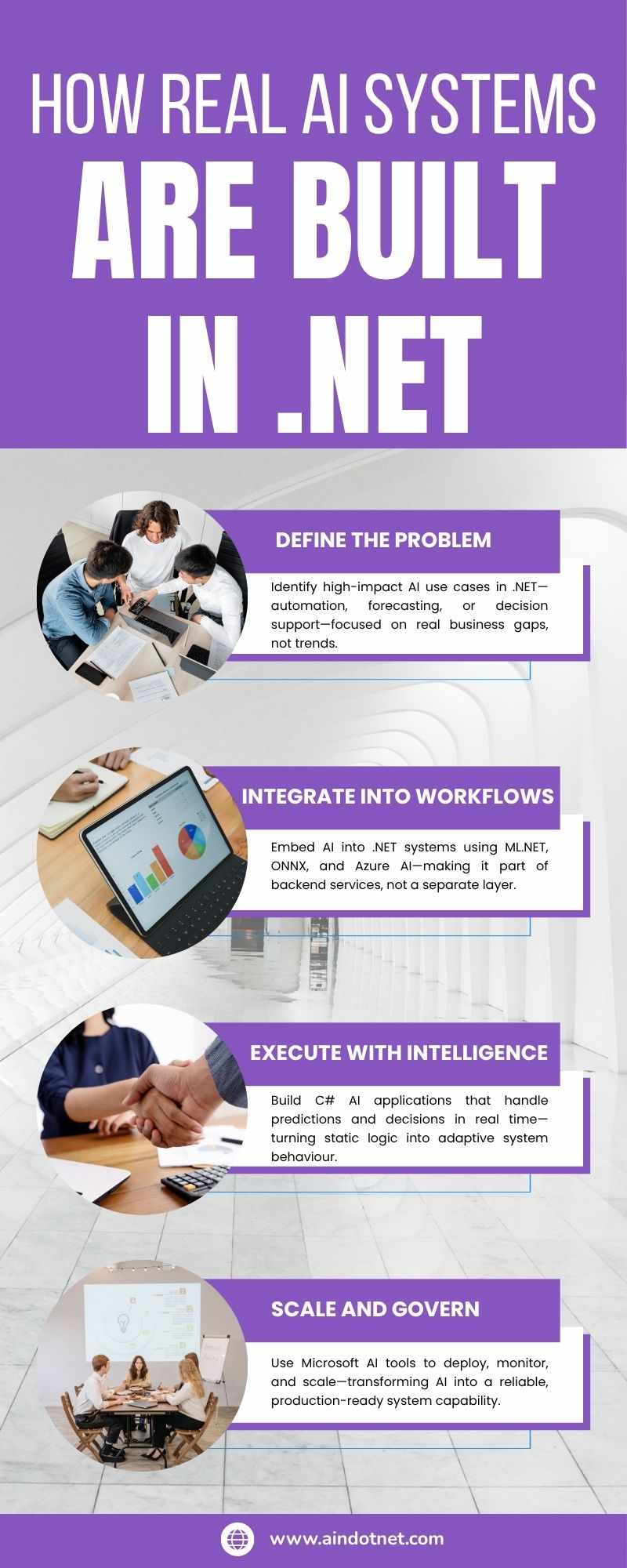
Define the problem: What’s the business challenge?
Collect data: Without data, AI can’t learn.
Design the model: Use tools like ML.NET or Azure ML Studio.
Implement the prototype: Build it in C# and test performance.
Evaluate results: Use KPIs to measure success.
Iterate: Refine the model and improve accuracy.
This rapid prototyping approach lets you fail fast, learn quickly, and pivot as needed.
Essential Tools, Frameworks, and Libraries
ML.NET: Machine learning for .NET apps
Azure ML: Cloud-based AI services
Accord.NET: A .NET machine learning framework
TensorFlow.NET: Bring TensorFlow models to C#
These tools simplify development and help bridge the gap between business with AI and technical teams.
Best AI Applications That Drive Business Value
Retail: Personalized recommendations boost sales
Finance: Fraud detection saves millions
Healthcare: AI-powered diagnostics improve patient care
Manufacturing: Predictive maintenance cuts downtime
Top AI Applications You Can Build with C#
Chatbots: Automate customer service 24/7
Recommendation engines: Personalize offers
Anomaly detection: Spot fraud, system failures, or data breaches
The best AI applications serve as efficient drivers, delivering measurable ROI.
Common Pitfalls and How to Avoid Them
Underestimating data needs: Good data is the backbone of AI
Poor integration: Connect your prototype with existing systems
Lack of cross-team alignment: Keep business, dev, and data teams in sync
Address these early, and you’ll save time, money, and headaches.
From Prototype to Production: Scaling AI with Confidence
Testing, Feedback Loops, and Iteration
Treat your AI prototype as a learning experiment. Use A/B testing, user feedback, and performance monitoring to improve continuously.
Collaborating Across Business, Dev, and Data Teams
Break down silos:
Hold joint planning sessions
Share goals across departments
Celebrate quick wins together
This creates buy-in and accelerates success.
Managing Risk and Compliance in AI Projects
Ensure data privacy and security
Address ethical concerns
Stay updated on regulations like GDPR
Key Benefits of AI and C# Prototype Development for Growing Businesses
Rapid Innovation: Test ideas quickly without heavy investment
Cost Efficiency: Avoid long, expensive development cycles
Flexibility: Pivot solutions based on early results
Competitive Advantage: Stay ahead in the market
Scalable Growth: Go from prototype to full-scale deployment smoothly
Conclusion: Empower Your Business with AI, The Smart Way
Implementing AI is no longer a novelty as businesses of all sizes are integrating it. By combining AI and C# prototype development, you can unlock powerful innovations, improve efficiency, and gain a serious edge in your industry.
If you’re ready to explore more, check out AI n Dot Net, your ultimate resource for everything AI and .NET. From AI books for beginners to hands-on tutorials, AI n Dot Net helps both developers and business leaders succeed with confidence.
Visit our website to start transforming your ideas into reality.
FAQs
1. Why is C# a top choice for AI prototyping?
C# integrates smoothly with the .NET ecosystem and leading cloud services, provides extensive libraries, and remains familiar to enterprise developers, making it well suited to rapid AI prototyping.
2. How can small businesses leverage AI without big budgets?
Focus on narrow, high-impact scenarios such as chatbots or demand forecasting. Open-source frameworks and pay-as-you-go cloud tools keep costs under control while still delivering significant value.
3. What is the timeline from prototype to production?
Timelines vary, but many teams move from concept to working prototype within several weeks, then progress to production deployment in a few months after performance targets and governance checks are met.
Write a comment ...